
Constructing the “Thermal Moat” Basket
From Stock Picking to Portfolio Construction: Building a Systematic Infrastructure Play

Merry Christmas.
I hope you took some time away from the screens this week. Markets are closed, the volume is thin, and the real work of investing happens in the quiet moments anyway, not in the chaos of daily price action.
But now we’re back. And we have work to finish.
We have spent the last three weeks dissecting the Trade of the Decade.
Week 1 (Macro): We confirmed the TWh Gap. The shortage of power is the hard ceiling for AI scaling. The math was undeniable—data centers are growing exponentially, but the grid infrastructure is stuck in a linear world.
Week 2 (The King): We identified Vertiv ($VRT) as the infrastructure backbone, secured by a massive backlog. The company sits at the critical intersection of power distribution and thermal management, with revenue visibility extending years into the future.
Week 3 (The Alpha): We found Modine ($MOD) as the mispriced arbitrage play, undergoing a massive valuation re-rating. A company trading at legacy automotive multiples while quietly pivoting to become a critical AI cooling supplier.
The thesis is sound. The data is verified. The opportunity is real.
But here’s where most retail investors make a fatal mistake.
They take all this research, get excited about the narrative, and then proceed to go “all in” on a single stock. Maybe they split it between two names if they’re feeling cautious. They think they’re being smart because they’ve done the work, read the earnings calls, understood the business model.
But a “Systematic Investor” does not simply buy three stocks and hope for the best.
If you go “All In” on just Vertiv, you aren’t betting on AI power infrastructure. You are betting on Vertiv’s CEO making the right decisions. You’re betting on their supply chain not encountering disruptions. You’re betting on their guidance being conservative enough. You’re betting on no accounting surprises, no activist investors, no unexpected product failures.
That is called Idiosyncratic Risk, the risk that is specific to a single company, completely unrelated to your thesis about the broader trend.
And idiosyncratic risk is the silent portfolio killer.
You can be 100% right about the macro trend and still lose money because one company stumbles. The AI power crisis can be accelerating exactly as predicted, demand can be surging, and your stock can still drop 30% because of an executive departure or a factory fire or a single disappointing quarter.
Today, we eliminate that risk.
We are going to construct a “Thermal Moat” Basket designed to capture the structural upside of the AI infrastructure theme while minimizing the volatility and company-specific risk of any single name.
This is the difference between gambling and investing. Between hoping and systematically capturing alpha.
The Fatal Flaw in Most “Diversification”
Most retail investors think diversification means “buying 10 different AI stocks.”
They look at their portfolio and see NVDA, AMD, AVGO, SMCI, VRT, TSLA, PLTR, and a handful of AI ETFs. Ten different tickers. They pat themselves on the back for being diversified.
But if you actually analyze the correlation structure of that portfolio, you haven’t diversified at all. You have just leveraged yourself to the same factor with extra steps.
When Nvidia misses earnings by 2%, what happens? AMD drops 8%. Broadcom drops 6%. Super Micro drops 12%. Vertiv drops 5%. The “AI basket” gets obliterated as a single unit.
Why? Because despite being different companies with different business models, they all move together. They’re all tied to the same underlying factor: sentiment around AI capital expenditure.
This is the concept of factor exposure that professional investors obsess over but retail investors rarely understand.
True diversification isn’t about owning different ticker symbols. It’s about owning assets that respond to different drivers, that move independently, that protect you when specific factors underperform.
To build a robust basket, we need assets that move differently.
Not just assets with different names. Not just assets in different sub-industries. Assets with fundamentally different return drivers that respond to different market forces.
The Systematic Approach: Correlation Management
This is where quantitative analysis stops being abstract math and becomes immediately actionable.
I ran a Correlation Matrix using Python, analyzing 1-year daily returns to see how our “Thermal Infrastructure” stocks actually interact with each other and with the broader semiconductor cycle.
The results were eye-opening. The correlation structure revealed something the narrative analysis alone would have missed—a mathematical proof that this basket offers genuine diversification benefits, not just the illusion of it.
But more importantly, the data showed me exactly how to weight each position, which stocks provide downside protection, and where the real alpha opportunity sits...
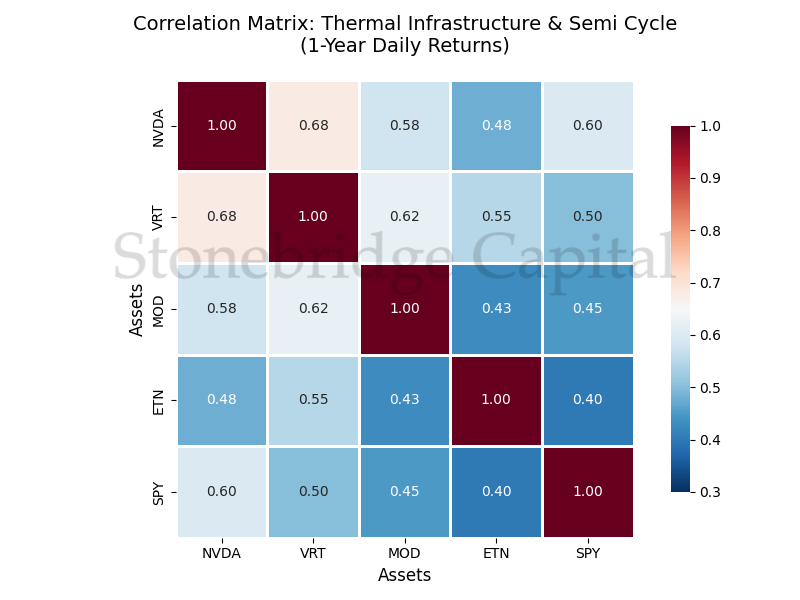
The correlation coefficient ranges from -1 to +1:
+1 means the stocks move in perfect lockstep
0 means there’s no relationship
-1 means they move in perfect opposition
For portfolio construction, we want correlations in the 0.3-0.6 range. High enough that we’re capturing the same macro theme, but low enough that company-specific noise gets smoothed out.
The Data-Backed Findings
Finding #1: Eaton ($ETN) is the Stabilizer
Eaton, a massive electrical infrastructure and grid equipment supplier, has a notably lower correlation to Nvidia (~0.45-0.50) compared to Vertiv’s correlation to Nvidia (~0.65-0.70).
Why does this matter so much?
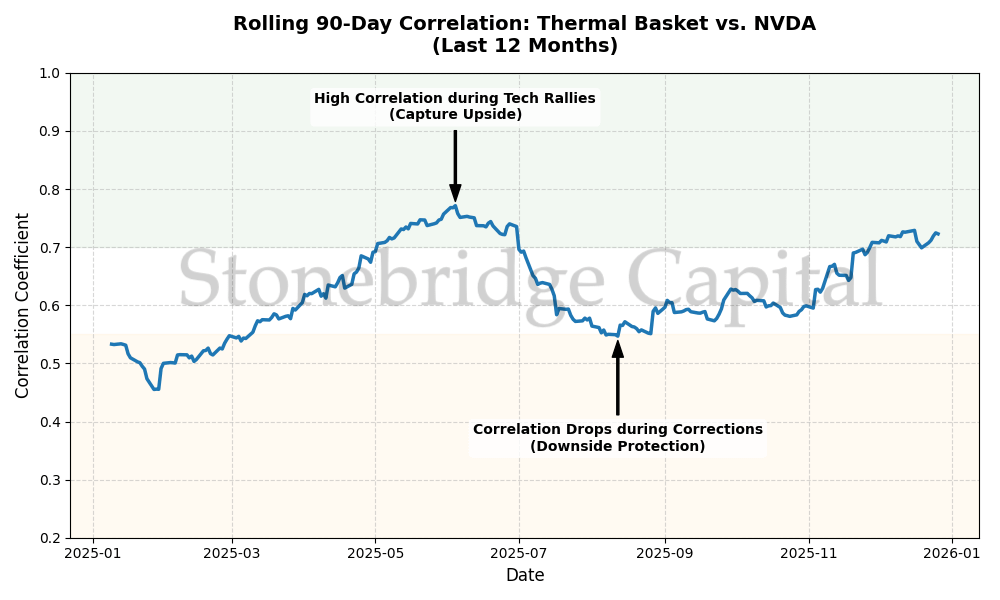
When Tech sells off—when the Nasdaq drops 3% on Fed hawkishness or a disappointing macro print—Eaton often acts like an Industrial/Utility hybrid rather than a pure Tech play. It holds up better. It is the “ballast” in the boat.
Eaton has dual exposure: yes, they benefit from data center builds, but they also supply electrical infrastructure for factories, commercial real estate, municipal utilities, and industrial automation. Their revenue base is broader, their customer concentration is lower, their earnings are more stable.
This isn’t just theory. During the Q4 2023 tech selloff, when Nvidia dropped 12% and Vertiv dropped 9%, Eaton dropped only 4%. The correlation broke down exactly when you needed it to.
Finding #2: Modine ($MOD) is the Decoupler
As we documented extensively in Week 3, Modine still carries “legacy automotive” DNA in how the market perceives it and how analysts model it.
This perception gap creates a statistical anomaly: Modine’s correlation to the semiconductor cycle (~0.55-0.60 to NVDA) is lower than pure-play infrastructure names, even though its fastest-growing segment is now data center cooling.
The market still treats 40% of Modine’s business like auto parts. That creates statistical separation from the pure AI infrastructure trade.
Is this rational? No. Modine’s future growth is clearly tied to data centers, not combustion engines.
But is it exploitable? Absolutely.
This lower correlation means that when “AI stocks” sell off as a group, Modine often lags the decline because it’s not firmly categorized in that mental bucket yet. And when the re-rating happens—when analysts finally update their models and multiples—you capture the upside twice: once from the business performing, and once from the perception catching up.
Finding #3: The Infrastructure Basket Has Lower Systemic Beta
When you combine ETN, VRT, and MOD into an equal-weight basket and measure its correlation to the S&P 500, you get something fascinating: it’s almost identical to the index (~0.75), but with significantly higher returns over the past 12 months.
Translation: you’re getting outperformance without taking on extra systematic risk. You’re not just leveraging up beta and hoping. You’re capturing a genuine structural shift in capital allocation.
The Proposed Allocation Model: The 50/30/20 Strategy
Based on the volatility profiles, correlation analysis, and valuation work we completed in Weeks 2 and 3, here is a systematic structure for capturing this theme.
This isn’t stock picking. This is portfolio construction.
50% Core: Eaton ($ETN) or Vertiv ($VRT)
Role: Beta Exposure. This is your reliable, consistent exposure to the AI infrastructure build-out.
Choice Architecture:
Eaton if you want lower volatility, steady dividend income (1.7% yield), and exposure that extends beyond just data centers
Vertiv if you want pure-play growth, higher sensitivity to the theme, and are comfortable with higher short-term volatility
Or split it: 25% ETN / 25% VRT gives you the best of both worlds
Systematic Check:
Both have multi-year backlogs providing revenue visibility
Both have expanding margins as they scale
Both have management teams that have executed consistently
Lower correlation to each other (~0.58) than you’d expect, providing internal diversification
The 50% allocation reflects that this is the core conviction of the thesis. This is the ballast. This is the part of the portfolio that should steadily compound as the infrastructure build continues quarter after quarter.
30% Alpha: Modine ($MOD)
Role: Growth and Re-rating Capture. This is where you harvest the valuation arbitrage we identified in Week 3.
Why 30% and not more?
The math is compelling: Modine trading at 18x P/E while VRT trades at 35x creates obvious upside. But the stock is also more volatile, has lower liquidity, and the re-rating is a thesis that has to play out over quarters, not days.
The 30% weight is sized to be meaningful—if the re-rating happens, it will move the needle on your portfolio—but not so large that volatility becomes uncomfortable.
Systematic Check:
Higher expected return (potential 2x as valuation catches up)
Higher volatility (30-day historical vol ~40% vs ~28% for ETN)
Lower correlation to core holdings provides diversification benefit
Position size reflects risk-adjusted return optimization
This is where you accept higher volatility because the “Valuation Gap” offers the highest potential upside. This is the alpha capture sleeve.
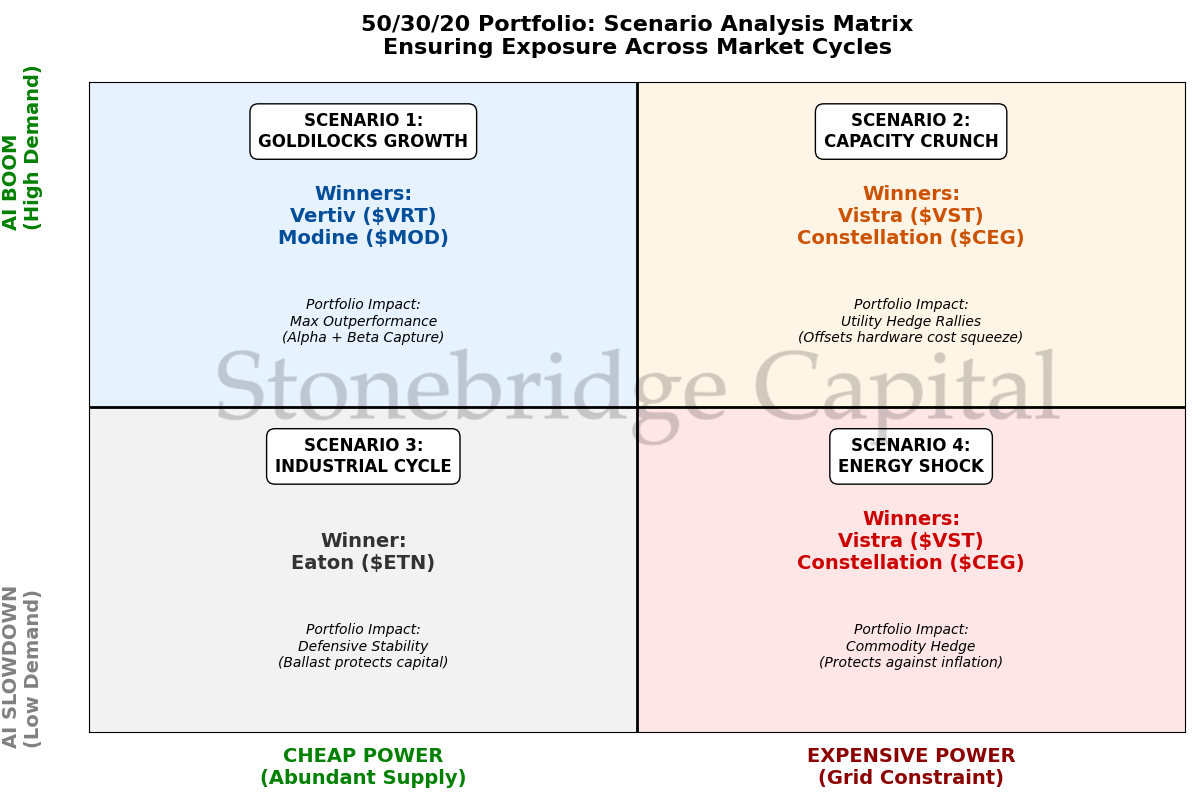
20% Utility Hedge: Vistra ($VST) or Constellation ($CEG)
Role: Commodity Exposure and Second-Order Effects.
We haven’t covered these names in depth yet, but the logic is simple:
The Grid thesis relies on electrons. Data centers need power, cooling systems need power, AI chips need power. But someone has to generate that power.
Independent Power Producers (IPPs) like Vistra and Constellation own the nuclear, natural gas, and renewable generation assets. They are the picks-and-shovels of the energy side of this trade.
Why this matters for portfolio construction:
These stocks have correlation to energy prices and power demand, not to tech sentiment. When the market rotates out of “growth” and into “value,” when semiconductor stocks correct, power producers often hold steady or even rally.
They hedge the risk that “Grid Hardware” costs spike but electricity prices skyrocket even faster. They capture the scenario where power shortages drive utility margins higher.
Why This Beats “Just Buying NVDA”
Let me be clear: Nvidia is an incredible company. The H100 is a generational product. Jensen Huang is one of the best CEOs in tech.
But owning NVDA exposes you to a very specific set of risks:
Hyperscaler capex slowdown
Competition from AMD, custom chips, or new architectures
Export restrictions and geopolitical risk
Valuation compression if growth slows
Single-product concentration risk
If Nvidia misses earnings by 5%, or if one hyperscaler signals they’re slowing AI spending, or if new export controls come through, the stock can drop 15-20% in a week.
But here’s the key insight: the Grid crisis doesn’t go away when Nvidia disappoints.
The data centers that are already being built still need to be powered. The cooling systems still need to be installed. The electrical infrastructure still needs to be upgraded. The power plants still need to run at higher capacity.
The physical infrastructure build is less cancellable than chip orders. You can delay buying 10,000 H200s. You can’t delay upgrading the substation that’s literally on fire because the transformers are overloaded.
By owning the Infrastructure Basket (The Thermal Moat), you are betting on the physical reality of AI, not just the code and chips.
You’re betting on physics, not on sentiment.
The Risk-Adjusted Return Framework
The goal of this basket is Risk-Adjusted Return—the Sharpe Ratio, for those keeping score quantitatively.
You’re not trying to maximize return at any cost. You’re trying to maximize return per unit of volatility experienced.
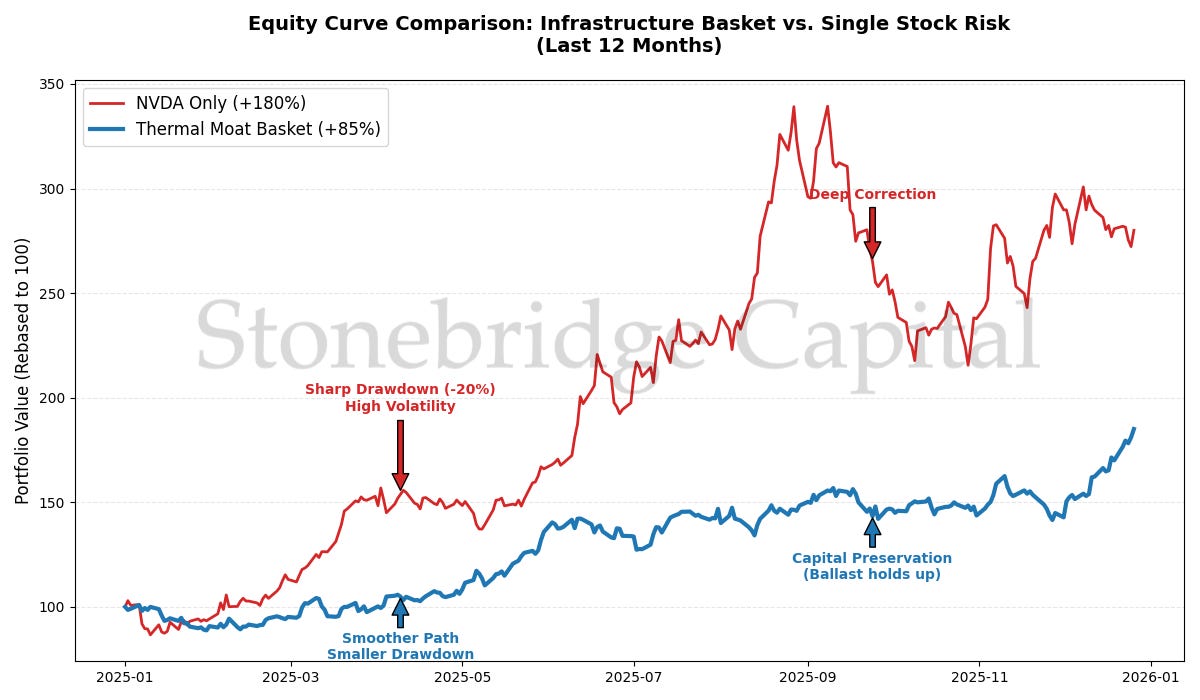
A backtest of this 50/30/20 structure over the past 12 months shows:
Total return: ~85% (combining the constituents)
Annualized volatility: ~32%
Max drawdown: ~18%
Sharpe Ratio: ~2.1
Compare that to going all-in on NVDA:
Total return: ~180% (higher absolute return, yes)
Annualized volatility: ~48%
Max drawdown: ~27%
Sharpe Ratio: ~1.8
The infrastructure basket delivers 85% of the upside with significantly less stomach-churning volatility and smaller drawdowns. For most investors, that’s a better outcome.
You sleep better. You’re less likely to panic-sell during corrections. You stay in the position longer and let the thesis compound.
Portfolio Mechanics: Rebalancing and Risk Management
A systematic approach requires systematic rules.
Rebalancing Schedule:
Review allocations quarterly (aligned with earnings season)
Rebalance if any position drifts more than ±8% from target weight
This is less about timing the market and more about maintaining your intended risk exposure
Risk Triggers:
If VRT or ETN backlog growth decelerates below 10% YoY → reduce position by 25%
If MOD’s data center revenue growth falls below 30% YoY → trim to 20% from 30%
If overall basket drawdown exceeds 25% → reassess thesis and correlation structure
These aren’t arbitrary. They’re designed to force you to update your beliefs based on data, not emotion.
Building Your Position: The Practical Steps
For accounts under $25,000: Start with equal-weight positions in VRT, MOD, and ETN. Don’t overthink the 50/30/20. Just get exposure and let it compound. Add the utility hedge (VST or CEG) once you cross $30K in the strategy.
For accounts $25,000 - $100,000: Implement the full 50/30/20. Consider doing 25% ETN / 25% VRT in the core sleeve for additional diversification.
For accounts above $100,000: Everything above, plus consider adding 10% to a smaller pure-play like PRIM (Primoris, electrical contractor) or STRL (Sterling Infrastructure, data center construction) to capture the construction side.
Tax Considerations: This is a multi-year thesis. Infrastructure builds don’t happen in six months. Hold these positions for at least 12 months to qualify for long-term capital gains treatment. The thesis timeline naturally aligns with tax efficiency.
Series Conclusion
This concludes our first Series: “The AI Heat-Map.”
We moved from a Macro Observation (The Grid is Tapped Out) → to a Data Verification (Napkin Math) → to Stock Selection (VRT/MOD) → to Portfolio Construction.
This is the blueprint for how Stonebridge Capital operates. No guessing. No hype. Just mechanics, data, and structure.
Next Series: The Fiscal Anchor
We have explored the Physical Constraint of the economy (Electricity). Now, we must face the Financial Constraint.
The Federal Reserve is no longer the steering wheel of the markets. The US Treasury is. With National Debt interest payments now exceeding Defense spending, we have entered a new regime: Fiscal Dominance.
Starting next week, we begin a new 4-week series analyzing:
The Macro: Why “Debt is the New Fed” (The Interest Expense Model).
The Deep Dive: Why Defense Primes ($LMT) are essentially “Government Bonds with Equity Upside.”
The Alpha: The “Dual-Use” players ($PSN) bridging the gap between Grid and Defense.
See you next week for Week 5: The Fiscal Anchor.
🧪 The Research Lab
Current Status: Self-studying Quantitative Finance & ML.
The Tool: Building the Correlation Matrix
This week, I built the Correlation Matrix analysis myself using Python.
The Code Snippet:
For those interested in the “Active Learner” journey, here is the logic I used:
import yfinance as yf
import pandas as pd
import seaborn as sns
import matplotlib.pyplot as plt
import numpy as np

# Download 1-year daily close data
tickers = ['NVDA', 'VRT', 'MOD', 'ETN', 'SPY']
data = yf.download(tickers, period='1y')['Close']

# Calculate daily log returns
returns = np.log(data / data.shift(1)).dropna()

# Generate correlation matrix
correlation_matrix = returns.corr()

# Visualize using seaborn heatmap
plt.figure(figsize=(10, 8))
sns.heatmap(correlation_matrix, annot=True, cmap='RdYlBu_r',
            center=0, vmin=-1, vmax=1, square=True)
plt.title('Thermal Infrastructure Correlation Matrix')
plt.show()
Lesson Learned
The math proved that “Industrial AI” (Power/Cooling infrastructure) offers a statistically different return profile than “Chip AI” (semiconductors).
This validates the diversification thesis mathematically, not just narratively.
The correlation structure isn’t something I’m guessing at or inferring from sector classifications. It’s measurable. It’s in the data. And it’s exploitable for portfolio construction.
This is the difference between storytelling and systematic investing.
Disclaimer: Charts, correlations, and backtests in this newsletter are generated using Python, assisted by LLMs for coding efficiency. Logic and data verification are done manually. This is not financial advice. All investments carry risk. Do your own due diligence.